Founder Burnout or Just a Hard Season? How to Tell the Difference
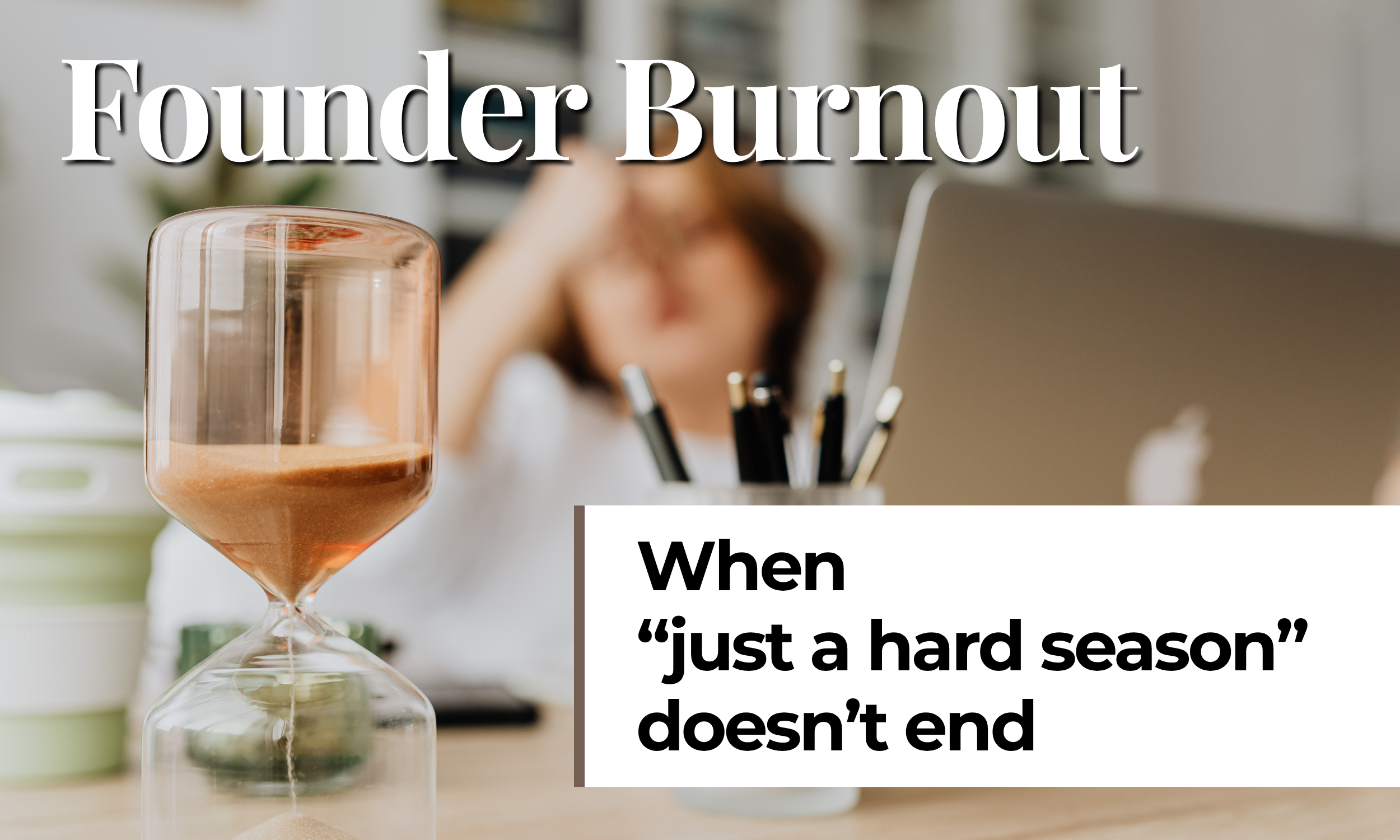
Is This Normal Founder Stress, or Something More?
From the outside, it looks like it’s working. The launch went fine. The numbers are holding. You posted the win, and people replied with fire emojis 🔥🔥🔥
And then it’s 11 p.m., and you're lying awake running the same loop… the thing you didn’t get to, the client you’re half-dreading, the quiet worry that everyone thinks you’ve got this handled and you're the only one who knows how thin the margin actually feels.
So which is it?
The kind of tired that comes with building something you care about — the stuff that clears after a good weekend? Or a pattern that's been following you for months, no matter how many wins land or how many things you cross off?
If you've ever Googled “am I burned out or just tired?” after a long day, you already know the question is worth asking.
The difference matters because the two can call for very different responses. A demanding season may ease when the pressure passes, while burnout can begin to affect the way you experience your work even when things are going relatively well.
So how do you tell the difference?
What Normal Entrepreneurial Stress Looks Like
Some stress is simply part of the deal when you're building a business. When you care deeply about an outcome you can't fully control, there will inevitably be launches that keep you up at night, difficult conversations that require more energy than expected, financial decisions that feel high-stakes, and days when everything seems to happen at once. Of course that can be stressful!
The important thing is that normal entrepreneurial stress tends to be situational. It might spike around a deadline, a major launch, a difficult client conversation or a particularly demanding season, but as the situation changes, your stress tends to come down with it.
You have a chance to recover. A good night's sleep helps. A weekend away from work gives you some energy back. Solving the problem brings a sense of relief. A win still feels like a win.
You may still have a long to-do list waiting for you on Monday, but you feel capable of facing it. You can reconnect with the reasons you decided to build the business in the first place.
A certain amount of pressure can even be useful. It can sharpen your focus, motivate you to prepare and help you channel your energy toward something that matters. The goal isn't to create a business where you never feel stressed; that's probably neither realistic nor particularly desirable.
The more important question is whether you can recover from the stress once the pressure passes.
How Do You Know When It's More Than a Hard Season?
There isn't a single checklist that can tell you whether you're experiencing founder burnout, but there are patterns worth noticing.
You might find that rest no longer seems to restore you. You take the weekend off, get some sleep or even go away for a few days, but return feeling as depleted as you were before.
You might notice that the things you used to enjoy have started to feel like obligations. The client conversations, creative work or problem-solving that once energized you now feel like items on a never-ending list.
Sometimes it looks like working more but feeling less effective. You're putting in longer hours, but your focus, creativity and decision-making don't seem to improve with them.
You may also become more reactive or cynical. A client's email bothers you more than it normally would. Small problems feel enormous. You have less patience with your team or the people around you.
And sometimes the clearest sign is that you can't switch off without feeling guilty. Even when you're technically taking time away from work, your mind is still there — checking your phone, thinking about tomorrow's list, or wondering what you should be doing instead.
Perhaps most importantly, you may start to feel as though the business and your sense of self-worth are becoming difficult to separate. When things are going well, you feel good about yourself. When something goes wrong, it feels like you've failed.
If several of these feel familiar, that doesn't necessarily mean you're burned out. But it may be worth asking what the pattern is telling you.

The Loneliness of Entrepreneurship
There is a strange paradox to being a founder: you can be surrounded by people all day and still feel completely alone.
You might have employees, clients, friends, family and a very full calendar, but very few people who understand what it's like to make decisions when there is no one above you making the final call.
You don’t want to burden your team. You don’t want to worry your family. You may feel that, as the founder, you're supposed to be the person who has the answers. And that can make it difficult to say, “I'm not sure.”
It can also make it difficult to recognize when you need support. Many entrepreneurs experience some version of the tension between how capable they appear on the outside and how much they're carrying on the inside.
Sometimes you don't need someone to tell you what to do. You need someone who can help you step back far enough to see what's actually happening.
What If Your Business Doesn't Have to Be Built Around Burnout?
Amanda Tobe has written about this question from her own experience as an entrepreneur and career counsellor.In Freedom in Entrepreneurship: Protecting the Plate in Front of You, Amanda describes intentionally designing her business around the life she wanted rather than allowing the business to dictate everything else. As Amanda puts it:
“Entrepreneurship doesn’t have to be built on burnout.”
That doesn't mean entrepreneurship should never be difficult. There will be seasons when you work harder, make sacrifices and navigate uncertainty. It means that burnout doesn't have to be the price of ambition. Instead of asking only, “How can I become better at handling everything on my plate?”, it can be useful to ask:
“Do I need everything that's currently on my plate?”
That might mean looking more closely at your workload, reconsidering what you can delegate, setting clearer boundaries or noticing the beliefs that keep you saying yes when your capacity is already stretched. The goal isn't to copy someone else's version of work-life balance. It's to understand what matters to you and whether your professional life is making room for it.
The Person Behind the Business Matters, Too
This is where the conversation about burnout becomes bigger than burnout itself.
Entrepreneurs don't only need support when they're completely depleted. You might be functioning well and still be wondering whether the way you're working is sustainable, whether you're making decisions for the right reasons, or whether the business you're building still reflects the life you actually want.
Maybe you're struggling to delegate. Maybe you're second-guessing decisions that used to come naturally. Maybe your business is growing and you're finding that the skills that got you here aren't necessarily the skills you need for what's next.
Or perhaps you're asking a much bigger question:
What do I actually want my professional life to look like?
These are psychological questions as much as business questions, and they deserve space.
Founder Behind the Business
This is part of the thinking behind Founder Behind the Business, Amanda Tobe & Associates' group offering for entrepreneurs.
The focus isn't simply on becoming more productive or finding another way to fit more into an already-full schedule. It's about creating space to consider the person behind the business — the person making the decisions, navigating uncertainty, managing relationships and trying to build something meaningful.
You may be the person everyone else looks to for confidence, but that doesn't mean you have to feel confident every minute.
You may be the person making the final decision, but that doesn't mean you have to make every decision alone.
And you may be building something you're incredibly proud of while also finding parts of it difficult.
Those things can all be true at the same time.
If you're curious about what it might look like to have more intentional support as you navigate entrepreneurship, book an introductory consultation with Amanda Tobe & Associates.

A Quick Founder Burnout Self-Check
This isn't a diagnostic test. Instead, think of it as an opportunity to pause and notice what's been happening.
Ask yourself:
Does my exhaustion persist even when I have time to rest?
Do my business wins still feel rewarding?
Am I increasingly detached or cynical about work I used to care about?
Do I struggle to switch off without feeling guilty?
Am I working longer hours without feeling more effective?
Has my business become closely tied to my sense of self-worth?
Do I feel like I have no one I can be completely honest with about how I'm doing?
If several of these questions feel uncomfortably familiar, it may be worth taking a closer look at what's happening.
Not because something is wrong with you.
Because something may need to change.
You Don't Have to Wait Until You're Burned Out to Ask for Help
You don't have to reach a crisis point before seeking support.
Sometimes the most useful time to ask for help is when you notice that something isn't working as well as it used to — before the exhaustion becomes overwhelming, before the resentment builds, or before you find yourself wondering how you ended up with a business that no longer feels like yours.
That support might involve working through boundaries, understanding patterns of perfectionism or self-doubt, navigating leadership challenges, or simply having a space to think through a difficult professional decision with someone who understands the psychological side of work.
Amanda Tobe & Associates provides career-focused psychological services for professionals and entrepreneurs, supporting clients through career development, confidence, leadership, entrepreneurship and the many psychological challenges that can accompany professional growth.
You don't have to wait until something is falling apart before deciding that you want your professional life to feel different.
The Bottom Line
Feeling stretched while you build something doesn't mean you're doing it wrong. Entrepreneurship is demanding, and there will always be seasons that ask more of you than others.
But if the difficult season never seems to end — if rest isn't restoring you, your wins don't feel like wins anymore, and the business you built has started to feel like something you're trapped inside — it's worth paying attention.
Burnout isn't a character flaw, and it doesn't mean you're weak or that you're not cut out to be an entrepreneur. It may simply be a sign that the way you're carrying the work isn't sustainable anymore.
You don't necessarily need to abandon your ambition.
You may just need to reconsider what you believe ambition is supposed to look like.
Because entrepreneurship doesn't have to be built on burnout.
And neither does a successful career.
Related Reading



Frequently Asked Questions
-
Burnout is recognized by the World Health Organization as an occupational phenomenon resulting from chronic workplace stress that has not been successfully managed. It is not classified as a medical condition in the ICD-11.
-
Stress is often connected to a specific demand or situation, while burnout is associated with chronic workplace stress and can involve exhaustion, increased mental distance or cynicism toward work, and reduced professional effectiveness.
One useful question is whether you're able to recover when the pressure decreases.
-
Recovery generally involves more than simply taking a few days off. If the conditions contributing to the stress remain unchanged, returning to the same workload and expectations can recreate the same cycle.
Looking at workload, boundaries, recovery and support can all be useful places to start.
-
No. You don't need to reach a crisis point before seeking support.
Psychological support can also be useful when you're functioning well but want to understand a pattern, navigate a transition, build confidence, develop your leadership skills or create a more sustainable approach to your career or business.
-
No.
Recognizing that something isn't sustainable can actually be an important form of self-awareness. The question isn't whether you can continue pushing yourself harder; it's whether the way you're working allows you to keep building the business and career you want without constantly pushing yourself past your limits.

Understanding and Overcoming Impostor Syndrome With Dr. Tracy Dalgleish | Podcast Episode
Are your self-doubts getting in your way? In this podcast episode, I speak to Dr. Tracy Dagleish, clinical psychologist and host of the podcast, about what impostor syndrome is and how it interferes with our ability to reach our potential.