
Imposter Syndrome vs. Self-Doubt: How to Tell the Difference
Am I Experiencing Imposter Syndrome, or Just Normal Self-Doubt?
You get the promotion, the new client, the acceptance email, and instead of relief, there’s a flicker of dread. Do they know I got lucky? How long until someone realizes I don’t actually belong here?
If that sounds familiar, you’ve probably already asked yourself the question: is this just normal self-doubt, the kind everyone feels when they’re stretched outside their comfort zone, or is it something more persistent? The difference matters more than it seems, because the two call for very different responses. One tends to resolve on its own. The other usually doesn’t.
Here’s how to tell them apart:
What Is Self-Doubt, Exactly?
Self-doubt is a normal, situational response to a genuine challenge – a new role, an unfamiliar audience, a skill you haven’t fully built yet. It shows up as a reasonable question: am I ready for this? And crucially, it tends to fade as competence and familiarity grow. Self-doubt can even be useful: it’s often what motivates you to prepare, care, and take a second look at your work before you send it.
What Is Imposter Syndrome?
Imposter syndrome (a term coined by psychologists Pauline Clance and Suzanne Imes in 1978) describes a persistent internal belief that you’re a fraud, despite clear external evidence of your competence. People experiencing it tend to attribute their success to luck, timing, or other people’s generosity rather than their own ability, and they carry a chronic, quiet fear of being “found out.” It’s a well-documented psychological pattern, and one of the most common things we help clients work through in individual counselling and in our fall groups.
The Key Difference: Does It Fade, or Does It Follow You?
The clearest test isn’t how intensely you feel it. It’s whether it fades as evidence accumulates, or follows you regardless of it.
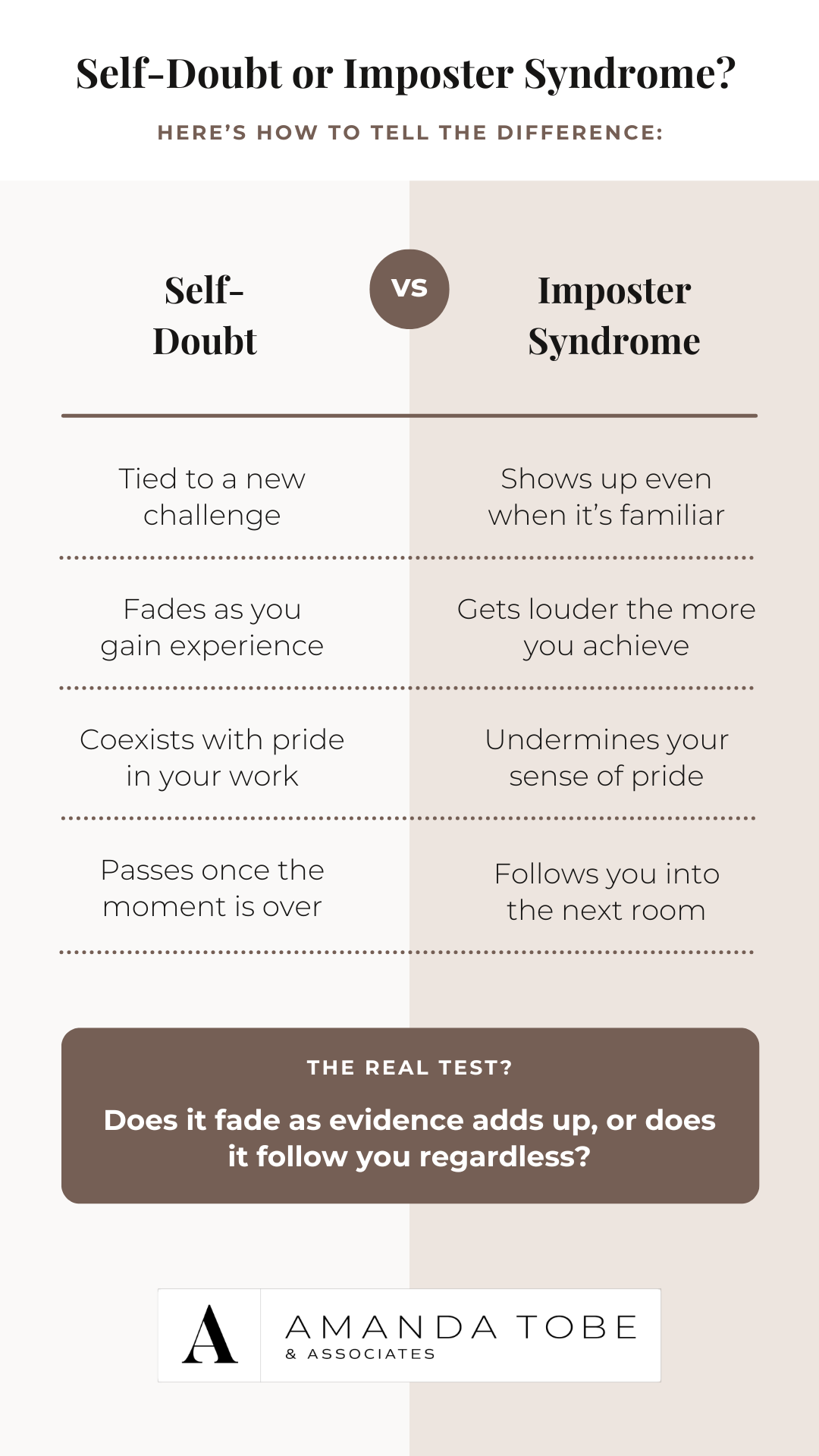
Normal Self-Doubt
Tied to a specific, new challenge
Fades as you gain experience or comfort
Coexists with pride in your work
Prompts reasonable preparation
Passes once the moment is over
Imposter Syndrome
Shows up across most situations, even familiar ones
Persists, and often intensifies, as you achieve more
Undermines your ability to internalize success
Prompts overworking, perfectionism, or avoidance
Follows you into the next role, the next win, the next room
Signs It Might Be More Than Self-Doubt
A few patterns worth paying attention to:
You dismiss compliments or credit your success to luck, timing, or other people
You feel like a fraud even in a role you’re objectively qualified for
You over-prepare or overwork to compensate for feeling “not enough”
You’ve turned down or hesitated on an opportunity you were qualified for, waiting to feel “ready enough”
The feeling hasn’t faded with experience. If anything, it gets louder as you take on more
Asking for help feels like admitting failure, so you avoid it
Why the Distinction Matters
Normal self-doubt isn’t usually costing you anything long-term, typically resolving itself as you settle into the new challenge. But imposter syndrome does carry a cost, because it’s chronic and identity-level rather than situational. Left unaddressed, it shows up as turned-down promotions, unspoken ideas in meetings, salary negotiations you didn’t start, and burnout from overworking to “prove” you belong. The good news: because it’s a pattern rather than a fixed trait, it responds well to structured work.
A Quick Self-Check
This isn’t a diagnosis – just a starting point. Answer yes or no:
Do you often credit your successes to luck, timing, or other people rather than your own ability?
Does the feeling of being “found out” persist even after positive feedback?
Do you over-prepare or overwork to feel “safe” in your role?
Have you hesitated on or turned down an opportunity you were qualified for?
Do you find it hard to accept a compliment about your work without deflecting?
Does this pattern show up in more than one area of your life, not just one high-stakes moment?
If you answered yes to three or more, what you’re experiencing may be more than everyday self-doubt.
Want the full picture?
Download the free Imposter Syndrome Self-Assessment: a short, private worksheet you can use to reflect at your own pace, with guidance on what your results mean. LINK to asset
When (and Why) to Get Support
Mild, situational self-doubt often doesn’t need intervention, and it resolves on its own. Persistent imposter syndrome usually benefits from structured support: naming the pattern, taking a second look at what was minimized, and rebuilding a more accurate story about your own competence. That’s the foundation of our Review, Rewrite, Rewire approach, and it’s the work we do together in the fall Imposter Syndrome Group.
Prefer to start one-on-one? Our individual Self-Confidence counselling works through many of the same patterns at your own pace. You can also book a consultation call if you’re not sure which option is the right fit.
The Bottom Line
Feeling unsure of yourself in a new situation doesn’t mean something is wrong – it usually means you’re growing. But if that doubt has followed you for years, regardless of what you’ve accomplished, it’s worth naming it for what it likely is. That’s not a character flaw. It’s a pattern, and patterns can change.
Related Reading:
Frequently Asked Questions
Is imposter syndrome a real diagnosis?
No, it’s not a clinical diagnosis in the DSM-5. It’s a well-documented psychological pattern, and one that responds well to the kind of structured, evidence-based support used in individual counselling and group work.
Can imposter syndrome go away on its own?
For some people, mild self-doubt resolves naturally with experience. Persistent imposter syndrome usually needs active work, like naming the pattern and building new evidence-based habits, rather than simply waiting it out.
What causes imposter syndrome?
Common contributors include perfectionism, early family or cultural messaging about achievement, being “first” or “only” in a role, and high-achieving or highly competitive environments where mistakes feel high-stakes.
Is imposter syndrome more common in women?
Clance and Imes’s original 1978 research focused on high-achieving women, but later research shows it affects people across genders, particularly those in underrepresented, highly visible, or high-scrutiny roles.

About Amanda Tobe & Associates
Amanda Tobe is a registered organizational psychologist who leads a team dedicated to helping professionals strengthen their confidence and thrive at work. Our services include career counselling, imposter syndrome counselling, public speaking anxiety support, and performance psychology for professionals across Ontario and Nova Scotia. We also provide entrepreneurial support and resources for business owners navigating self-doubt, decision-making, and mindset challenges as they grow their careers.
If you're ready to build confidence, navigate your career with clarity, and develop the skills to move forward, explore our services at amandatobe.com.