Toastmasters vs Private Public Speaking Coaching: Which is Better for Anxiety?

You have a presentation coming up.
You know your material. You've prepared. And you're still dreading it.
Maybe you lie awake replaying a meeting from last week. Maybe your heart races when someone puts you on the spot. Maybe a quiet voice in your head asks: Why is this so hard for me? What's wrong with me?
If that sounds familiar, you may have already heard the advice: "Just join Toastmasters."
Toastmasters is the most widely known public speaking organization in the world. It works well for many people. But for those dealing with genuine public speaking anxiety or fear of public speaking, it may not be enough.
This post explains why, and what a different kind of support looks like.
What Toastmasters Does Well
To be fair: Toastmasters is excellent for the right person.
Each meeting follows a consistent structure. Members give prepared speeches, practice impromptu speaking (called Table Topics), and take on rotating roles. You get a lot of speaking reps in a short period of time.
Membership is open and rolling. Chapters exist in cities worldwide, and many companies host their own. The community tends to be warm and enthusiastic. For many members, public speaking is genuinely a hobby they enjoy.
Toastmasters is a great fit if you: have low to moderate anxiety, want more practice in front of others, and enjoy the craft of communication.

Where Toastmasters Falls Short for High Anxiety
The foundation of Toastmasters is repeated exposure: the idea that the more you speak in front of others, the less scary it becomes.
That is partly true. But for people with high public speaking anxiety, exposure alone is rarely enough.
Without the right tools, repeated exposure can actually make anxiety worse. If every meeting leaves you feeling like you failed, or that everyone noticed your shaking hands, more practice just adds more evidence to the story you're already telling yourself.
Toastmasters also does not teach specific anxiety management techniques. That is not a criticism. The program is built around the craft of speaking, not the psychology of fear.
And the beliefs that drive high anxiety? Those need a different kind of attention entirely.
Beliefs like:
Why am I so bad at this?
What's wrong with me?
What will people think of my competence if they see me struggle?
These are not solved by more speaking reps.
According to the American Psychological Association, anxiety around public speaking often stems from the fear of negative evaluation. It can trigger real physical symptoms: racing heart, shaky voice, difficulty concentrating, and shortness of breath. These responses need targeted strategies, not just more practice.
The Mayo Clinic notes that for some people, fear of public speaking meets the criteria for a specific phobia, sometimes called glossophobia. In those cases, professional support and structured therapeutic tools are often recommended alongside or before exposure practice.
Who Our Public Speaking Group Is Designed For
Our group is for people who self-identify as having a genuine fear of public speaking, or who struggle with public speaking self-confidence in a way that affects their work or sense of self.
You may be a good fit if:
You already know your material, but feel hijacked by anxiety when it's time to speak
You want to understand and manage anxiety, not just push past it
You are open to practicing in a small, supportive group setting
You want to learn about the science and psychology behind what you're experiencing
This is not for people who want quick tips or performance-focused coaching. It is for people who are ready to do real work on the inside.
Because everyone in the group is coming from the same honest place, membership is closed and pre-screened. You will apply before joining. That shared context is part of what makes the work possible.
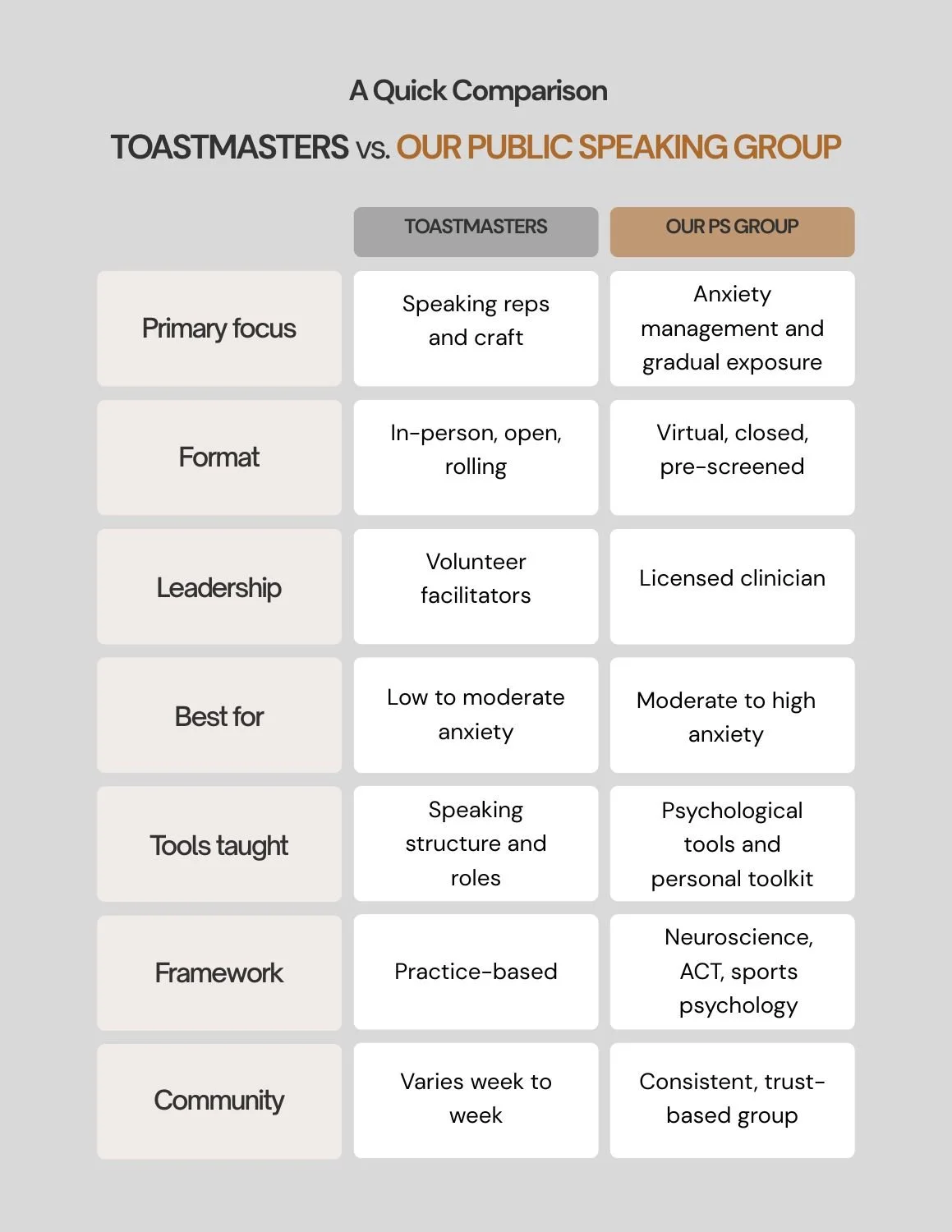
How Our Approach Is Different
1. Gradual Desensitization at Your Own Pace
We do include speaking practice, but exposure is not the starting point.
Gradual desensitization means starting small and safe. Something like introducing yourself to one person, or sharing a few sentences in a supportive setting. Then, step by step, building toward bigger challenges.
This approach gives your nervous system time to build a sense of safety before asking you to take on more. Over time, that is what reduces public speaking anxiety and builds lasting confidence.
This is different from Toastmasters, where the expectation from day one is to stand up and speak in front of the group.
2. Facilitated by a Psychologist
Our group is led by a licensed psychologist. That is central to the work, not incidental.Public speaking anxiety is a psychological experience. It involves the nervous system, deeply held beliefs about identity and worthiness, and the fear of judgment. A facilitator trained in psychology can address what is actually driving the fear, not just the surface symptoms.

3. Your Own Personal Toolkit
In this group, you will not just practice speaking. You will learn why anxiety shows up and how to work with it skillfully when it does.
You will leave with a personalized set of tools to use in real situations: before a big presentation, mid-meeting when your mind goes blank, or when your face flushes red. The goal is not to eliminate anxiety. It is to stop being controlled by it.
4. Understanding the Psychology Behind the Fear
A significant part of each session is discussion-based.
We explore why public speaking feels so high-stakes, and how social anxiety and performance-based identity can make even small speaking moments feel threatening. We also work on building the capacity to tolerate embarrassment, which is the core emotion at the heart of most public speaking anxiety.
When you can sit with embarrassment instead of fleeing from it, everything changes.
5. A Science-Backed Framework
Our approach draws from three fields:
Neuroscience: How the brain processes threat and why public speaking can trigger a fear response
Clinical psychology: Including mindfulness and Acceptance and Commitment Therapy (ACT), which focuses on changing your relationship to difficult thoughts, not eliminating them
Sports psychology: How high-performance athletes manage pressure and mental blocks
This is not intuition-based coaching. It is evidence-based, and it is designed for people who want to understand what is happening, not just survive it.
6. Real Community and Accountability
Each session opens with "speaking shares," a chance to discuss wins and challenges from the week. This is not small talk. It builds continuity, normalizes the struggle, and creates genuine connection with people who understand what you are going through.
Between sessions, you will receive weekly homework. Small, specific assignments to try in real life. Because real change does not happen in the meeting room alone.
And because the group is closed, the same people show up every week. That consistency builds something rare: real trust, real rapport, real accountability.
The Bottom Line
Toastmasters and our group are not competing with each other. They serve genuinely different needs.
If you enjoy public speaking or want more practice in front of an audience, Toastmasters is a wonderful community. Find a chapter near you.
But if fear of public speaking affects your work, your confidence, or your sense of self, more reps may not be the answer. If the anxiety touches something deeper, something about your identity or your fear of being judged, you may need a different kind of support.
That is what we are here for.
Frequently Asked Questions
What is glossophobia? Glossophobia is the clinical term for an intense, persistent fear of public speaking. It is considered a specific phobia and affects an estimated 25 percent of people. Unlike general nervousness, glossophobia can cause significant distress and avoidance that interferes with daily life and professional performance.
Is fear of public speaking the same as social anxiety? They overlap, but are not identical. Social anxiety is a broader condition involving fear of social situations and judgment from others. Public speaking anxiety or glossophobia is more specific. Some people with public speaking anxiety do not struggle in other social situations, while others do. A psychologist can help you understand which applies to you.
How do I know if a public speaking class or group is right for me? If you want more reps and enjoy the craft of communication, a public speaking class or group like Toastmasters may be a great fit. If your anxiety feels deeper, involving beliefs about yourself, physical symptoms, or avoidance, a psychology-informed group is likely a better starting point.
Ready to take the next step? Learn more about our psychologist-led public speaking anxiety group or join the waitlist.
About Amanda Tobe & Associates
Amanda Tobe is a registered organizational psychologist who leads a team dedicated to helping professionals strengthen their confidence and thrive at work. Our services include career counselling, imposter syndrome counselling, public speaking anxiety support, and performance psychology for professionals across Ontario and Nova Scotia. We also provide entrepreneurial support and resources for business owners navigating self-doubt, decision-making, and mindset challenges as they grow their careers.
If you're ready to build confidence, navigate your career with clarity, and develop the skills to move forward, explore our services at amandatobe.com.
